

NEW YORK | JATIMSATUNEWS.COM: A federal jury in Brooklyn, New York, has found Chinese telecommunications giant Huawei Technologies Co. and three of its subsidiaries guilty on 10 of 12 criminal counts.
Their discovery concludes a sprawling, decade-long legal battle centered on covert business dealings in Iran, international bank fraud, and corporate espionage.
The verdict, delivered late Tuesday (November 24) following a nearly three-month trial and five days of jury deliberations.
This outcome marks a historic milestone in the U.S. government’s efforts to enforce its sanctions regime and protect domestic intellectual property against foreign state-backed enterprises.
The jury convicted Huawei of violating U.S. sanctions against Iran, bank and wire fraud, money laundering conspiracy, and conspiring to steal trade secrets from American competitors.
However, the jury acquitted the company of the two most sweeping charges; racketeering conspiracy and conspiracy to obstruct justice.
U.S. District Judge Ann M. Donnelly has scheduled sentencing for September 14, 2027, where the Shenzhen-based tech titan faces massive potential financial penalties, including heavy criminal fines, asset forfeiture, and restitution.
Highlights
Huawei Convicted in U.S. Trial
The Covert Iranian Connection: Skycom and Global Banking
At the heart of the prosecution’s case was Huawei’s clandestine operation in the Islamic Republic of Iran, a country heavily sanctioned by Washington over its nuclear program and regional activities.
Throughout the 12-week trial, federal prosecutors presented evidence demonstrating that Huawei used a Hong Kong-registered shell company, Skycom Tech Co., Ltd., as an unofficial, wholly owned subsidiary to conduct business in Tehran.
According to trial testimony and corporate records, the Shenzen based company transferred Skycom’s shares between Huawei-controlled entities in 2007 while falsely representing to the outside world, that Skycom was merely an independent local business partner.
Prosecutors proved that the company also maintained operational and financial control over Skycom, using the entity to supply telecommunications infrastructure and advanced surveillance technology to the Iranian government.
Evidence presented in court indicated that these systems helped Iranian authorities monitor and censor internet traffic as well as track political protesters.
Because U.S. sanctions prohibit the use of the American financial system to clear U.S. dollar transactions benefiting Iran, Huawei’s alleged deception of global banks formed the basis of the bank and wire fraud convictions.
Prosecutors detailed how the company executives repeatedly misled major lenders—including HSBC, Standard Chartered, and BNP Paribas—about the true nature of its relationship with Skycom.
By claiming it had restricted its Iranian operations as early as 2011 when business actually continued for at least another decade, the Chinese company secured billions of dollars in credit, loans, and access to U.S. dollar clearing services that would have otherwise been denied.
“Today’s verdict is a step towards accountability for Huawei’s criminal activities, which includes yearslong collaboration with sanctioned entities in Iran, repeated lies to banks, and blatant thefts from U.S. technology companies,” U.S. Attorney Joseph Nocella Jr. stated following the verdict.
A Diplomatic Flashpoint: The Meng Wanzhou Saga
The criminal prosecution that culminated in Tuesday’s verdict originally erupted onto the global stage in December 2018, triggering a severe diplomatic crisis between Washington, Beijing, and Ottawa.
At the request of U.S. authorities, Canadian police arrested Huawei’s Chief Financial Officer, Meng Wanzhou—who is also the daughter of Huawei founder Ren Zhengfei—during a stopover in Vancouver.
Meng was indicted for allegedly lying directly to an HSBC executive during a 2013 meeting in Hong Kong regarding Huawei’s control over Skycom.
Her arrest sparked intense geopolitical fallout; Beijing subsequently detained two Canadian citizens in what Western governments widely condemned as retaliatory “hostage diplomacy,” while Washington and Beijing remained locked in an escalating trade war.
Meng fought extradition to the United States from a mansion in Vancouver under GPS monitoring for nearly three years.
In September 2021, she reached a deferred prosecution agreement with the U.S. Department of Justice.
Under the terms of the deal, Meng did not plead guilty or pay a fine, but she formally acknowledged a statement of facts confirming that the company controlled Skycom and that she had made misleading representations to HSBC.
She returned to China to a hero’s welcome—coinciding with the release of the two detained Canadians—and a federal judge formally dismissed the individual charges against her in December 2022.
However, the corporate prosecution against Huawei and its affiliates pressed forward, with the very HSBC executive Meng met in 2013 testifying during the Brooklyn trial.
Espionage and Trade Secret Theft

Beyond the Iranian sanctions violations, the trial spotlighted the broader technological rivalry between the United States and China.
In 2020, the Justice Department expanded its original indictment to accuse the Chinese company of a decades-long conspiracy to steal proprietary technology from American firms.
Prosecutors called more than 60 witnesses to illustrate what Assistant U.S. Attorney Taylor Stout described in opening statements as a “culture of crime and corruption” used as a core business strategy.
The jury heard testimony regarding multiple instances of intellectual property theft, including allegations that the company engineers stole confidential specifications and parts from “Tappy,” a robotic arm developed by T-Mobile USA to test smartphone touchscreens.
Other counts involved accusations that Huawei copied proprietary router source code from Cisco Systems and improperly obtained circuit board technology from Silicon Valley startup CNEX Labs.
Read also: Nvidia Reinstates Co-Founder Jensen Huang as President and CEO in Dramatic Board Reversal
Huawei’s Defense and Geopolitical Aftermath
Throughout the trial, Huawei’s defense team, which called 15 witnesses, argued that the U.S. government had “cherry-picked” isolated compliance failures and employee misconduct over decades of global operations to manufacture a sweeping conspiracy.
Defense attorney Brian Heberlig contended that Huawei’s rise as a global telecommunications leader was driven by legitimate competition and massive investment—citing the company’s 110,000-strong research and development workforce and over 165,000 patents—rather than theft.
Following the verdict, Heberlig expressed disappointment over the 10 convictions while welcoming the jury’s decision to clear the company of racketeering.
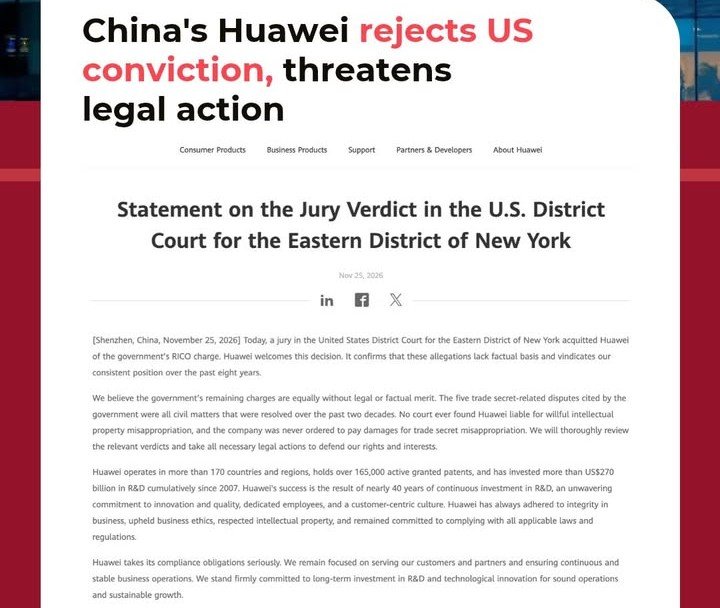
“We fully expect to appeal,” Heberlig told reporters outside the Brooklyn courthouse. In an official statement, the company maintained that the remaining charges lacked legal and factual merit, vowing to take all necessary legal actions to defend its rights.
In Beijing, the Chinese Foreign Ministry has consistently denounced the prosecution as politically motivated “lawfare” aimed at suppressing the rise of Chinese high-tech enterprises.
Since the investigation began, Washington has placed Huawei on a strict U.S. trade blacklist, cutting off its access to American semiconductors and software, while pressuring European and Asian allies to strip Huawei equipment from their next-generation 5G networks.
Despite the relentless legal and economic pressure from Washington, analysts note that the Chinese company has demonstrated remarkable resilience.
Forced to adapt by U.S. export controls, the company has pivoted aggressively toward domestic chipmaking, electric vehicle software, and artificial intelligence, emerging as a central pillar of China’s push for technological self-reliance.
Nonetheless, Tuesday’s historic conviction cements a contentious chapter in U.S.-China-Iran relations, underscoring the far-reaching extraterritorial power of American sanctions and criminal law.***
Author: YAN






Komentar Pembaca
Belum ada komentar pada artikel ini. Jadilah yang pertama.
Minimal 10 karakter, maksimal 1000. Maksimal satu tautan. Semua komentar ditinjau redaksi sebelum tampil.