

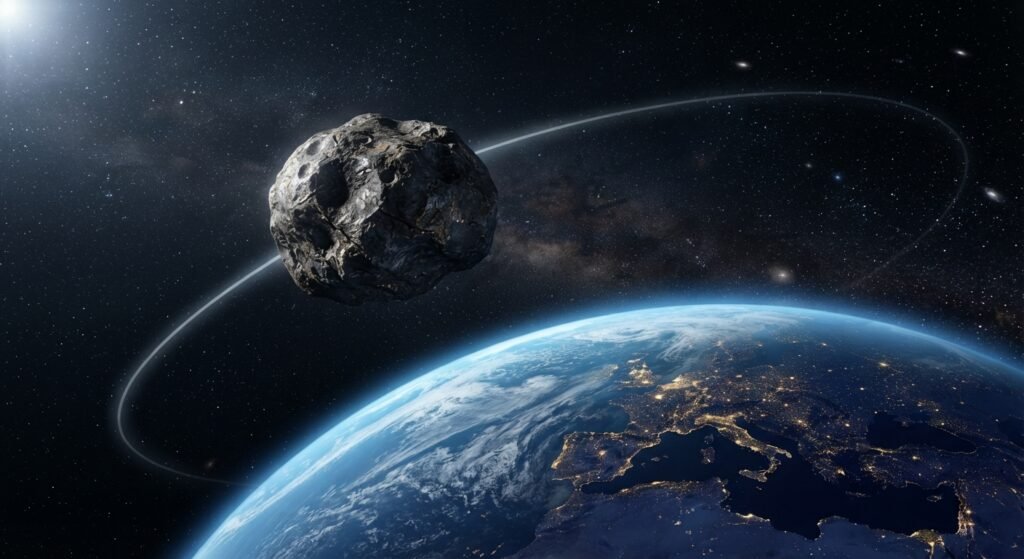
MASSACHUSETTS | JATIMSATUNEWS.COM: For the past several months, Earth has been quietly accompanied by a tiny celestial hitchhiker—an asteroid designated 2026 QQ8.
Astronomers and space agencies have confirmed that a small near-Earth asteroid, officially designated 2026 QQ8, has been temporarily captured by our planet’s gravitational pull.
The asteroid acts as a fleeting “mini-moon” before it prepares to break free and resume its solitary journey around the sun in early December.
The discovery, formally announced by the International Astronomical Union’s Minor Planet Center (MPC)—an organization based in Massachusetts—highlights the dynamic and often unseen gravitational dance occurring just beyond our atmosphere.
Measuring roughly 2 meters (about 6 feet) in diameter, 2026 QQ8 is approximately the size of a compact car or a large household appliance, making it a microscopic companion compared to Earth’s permanent Moon, which spans 3,475 kilometers (2,159 miles) across.
Highlights
Asteroid 2026 QQ8
A Tricky Detection and Celestial Debate
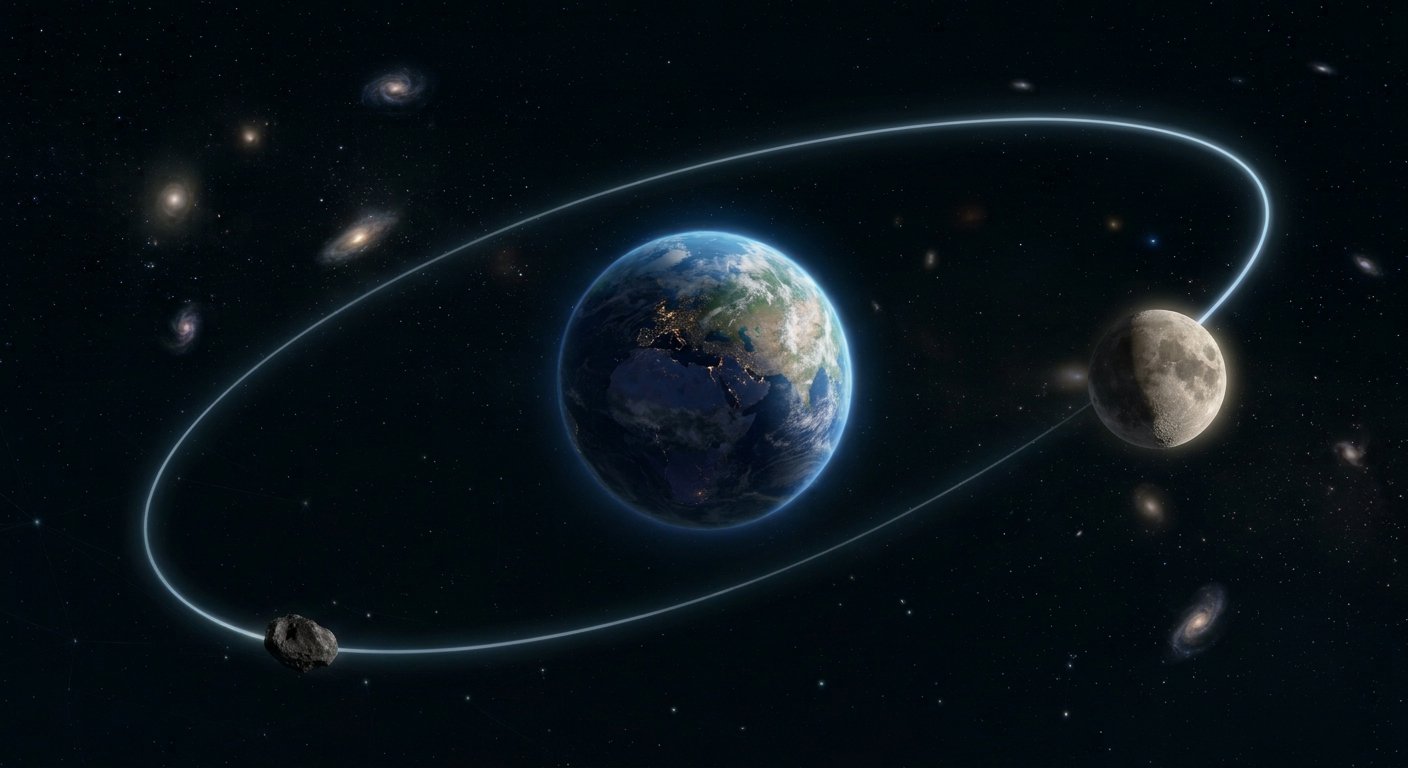
Unlike our familiar lunar neighbor, 2026 QQ8 is far too small and faint to be seen with the naked eye or even standard backyard telescopes.
In fact, its diminutive size initially sparked a spirited debate within the astronomical community over whether the object was a natural space rock or merely a stray piece of human-made space junk, such as a defunct satellite or a spent rocket booster from decades of space exploration.
Hungarian astronomer, Krisztian Sarneczky first spotted the faint object in August 2026. At the time, it was cataloged as an ordinary near-Earth asteroid passing through the inner solar system.
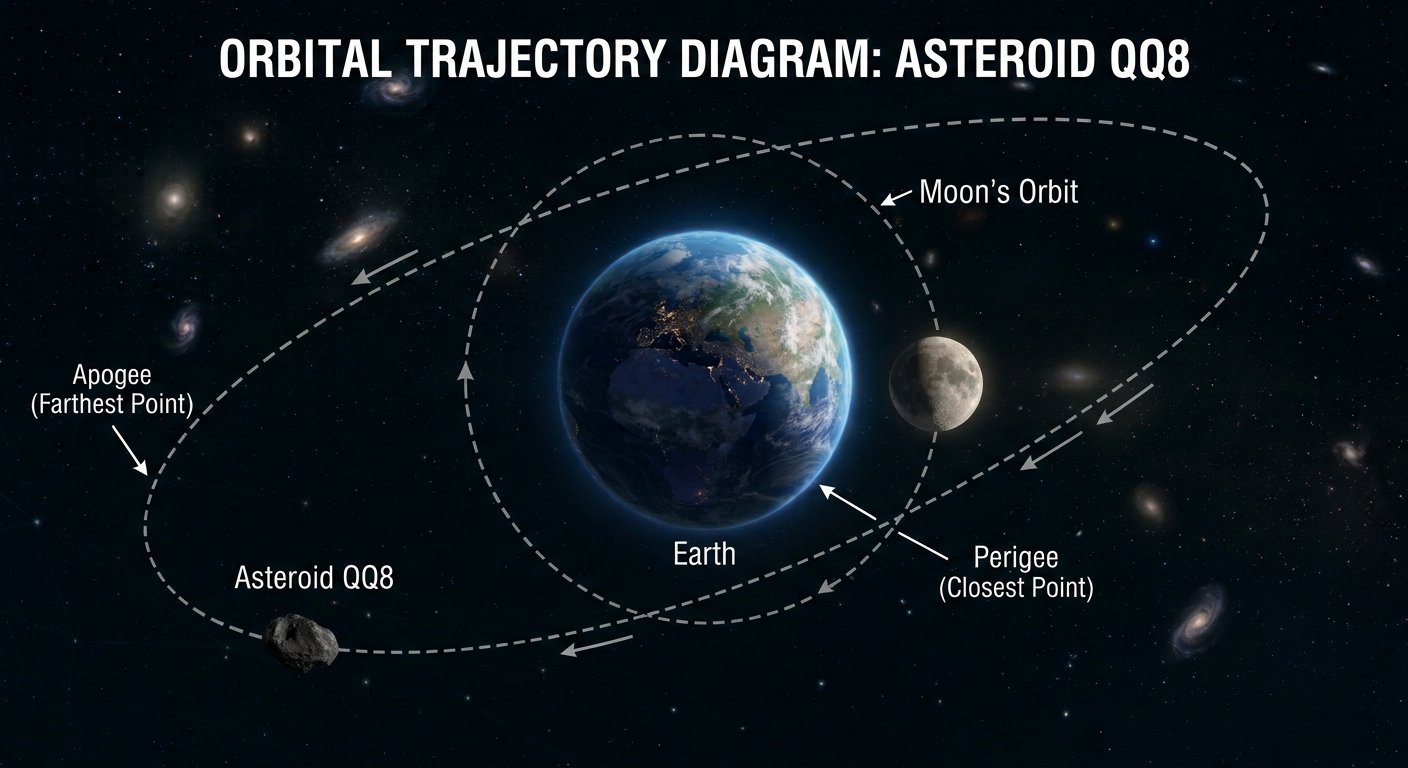
However, subsequent orbital reconstructions revealed a much more intriguing story: Earth’s gravity had actually snared 2026 QQ8 back in April 2026, pulling it into a looping, temporary orbit around the planet.
To verify its natural origin, astronomers turned to some of the world’s most powerful ground-based observatories, including the Lowell Discovery Telescope in Arizona and the University of Hawaii’s 2.2-meter (88-inch) telescope atop Mauna Kea.
By meticulously tracking how solar radiation pressure subtly nudged the object’s trajectory over several weeks, researchers confirmed that 2026 QQ8 is indeed a solid, natural asteroid. By late October, the Minor Planet Center officially bestowed its designation.
No Threat to Earth
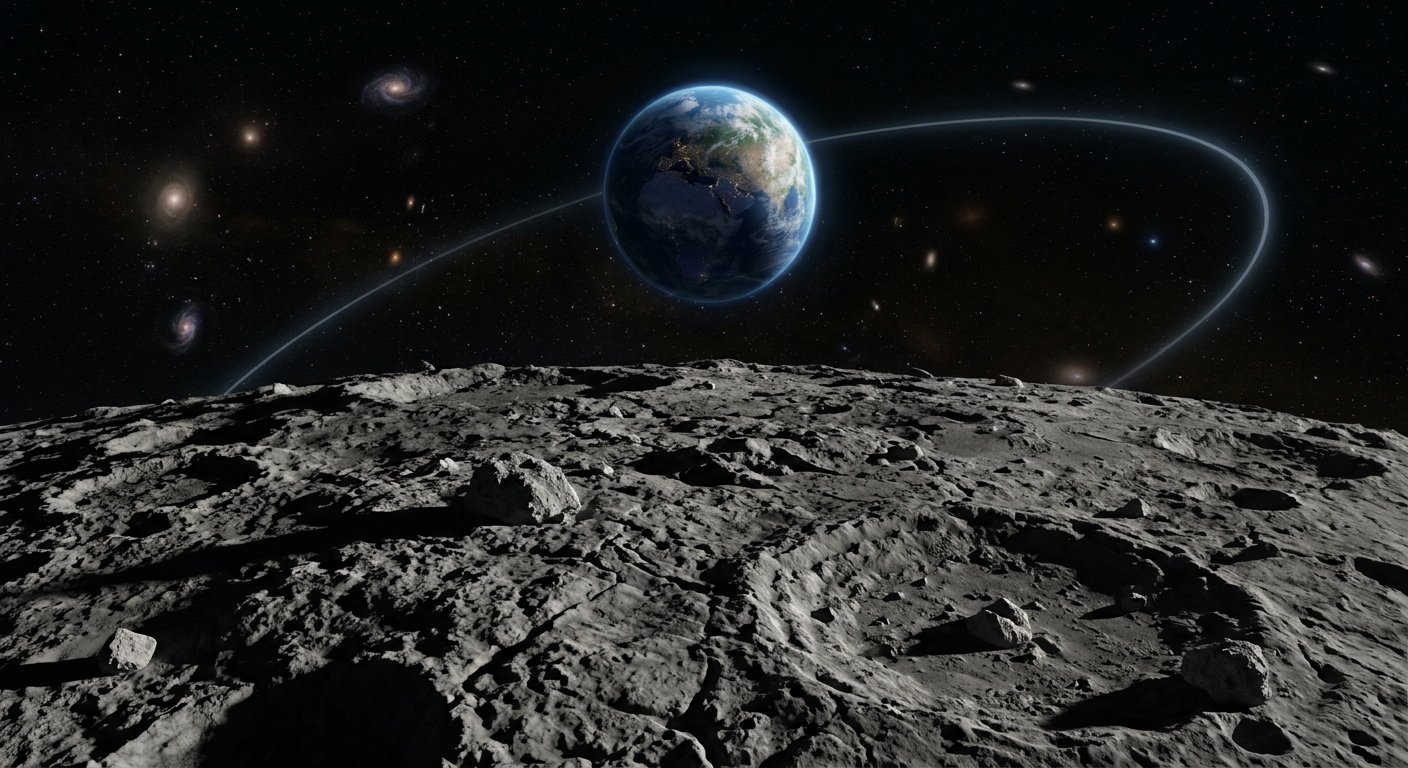
Whenever news breaks of an asteroid lingering near Earth, public concern naturally turns to planetary defense. However, space experts emphasize that 2026 QQ8 poses zero threat to our planet.
According to orbital data analyzed by the MPC and NASA’s Center for Near-Earth Object Studies (CNEOS), the asteroid’s closest approach keeps it at roughly 353,000 miles (568,000 kilometers) from Earth—well beyond the average distance of our permanent Moon.
Furthermore, Matthew Payne, director of the Minor Planet Center, noted that even in a hypothetical scenario where 2026 QQ8 were to veer into Earth’s atmosphere, its 6-foot frame would disintegrate completely due to atmospheric friction long before reaching the ground.
“At best, you would get a bright meteor in the sky and a bit of a bang,” Payne explained in an interview with CNN.
How Earth Captures Temporary Moons
While the term “mini-moon” is an informal moniker rather than an official scientific classification, the phenomenon is a well-documented aspect of orbital mechanics.
Most near-Earth objects originate in the main asteroid belt situated between Mars and Jupiter.
Over millions of years, gravitational nudges from giant planets like Jupiter can knock smaller rocky fragments out of the belt, sending them inward toward the sun.
Occasionally, one of these displaced asteroids will approach the Earth-Moon system at a unusually slow relative velocity. If the speed and angle are just right, Earth’s gravitational field can temporarily trap the space rock, pulling it into a complex, looping trajectory around the planet.
“On average, there’s probably one there at any given time,” Payne said, noting that these transient companions usually go undetected because they move swiftly across the sky and reflect very little sunlight.
“They hang around for a few weeks or months. Sometimes it’s none, sometimes it’s a couple.”
Historical records show a small but growing catalog of confirmed mini-moons. In 2006, an asteroid named 2006 RH120 remained gravitationally bound to Earth for roughly a year.
More famously, 2020 CD3 orbited our planet for nearly three years before escaping back into solar orbit in 2020.
More recently, in late 2024, a larger 10-meter (33-foot) asteroid named 2024 PT5 captured global headlines when it looped near Earth for nearly two months.
Subsequent spectroscopic studies published by NASA in early 2025 revealed that 2024 PT5 was likely an ancient chunk of rock blasted off our own Moon by a past meteorite impact.
A Brief Farewell and Scientific Value
For 2026 QQ8, its time as Earth’s secondary satellite is rapidly drawing to a close.
Orbital models indicate that the asteroid completes a revolution around the sun in roughly 359 days—nearly identical to an Earth year—and typically passes near our planet once every decade.
During this 2026 encounter, the alignment was close enough to trigger a multi-month capture.
However, by early December 2026, the sun’s immense gravitational pull will overcome Earth’s grip, tugging 2026 QQ8 out of its geocentric loop and back into its standard heliocentric orbit.
Despite their brief stays, astronomers view mini-moons like 2026 QQ8 as invaluable natural laboratories.
Studying their trajectories helps scientists refine mathematical models of near-Earth space and improve automated sky-survey systems designed to detect potentially hazardous asteroids.
Additionally, because these objects linger relatively close to Earth at low velocities, planetary scientists consider future mini-moons prime targets for robotic spacecraft missions.
This is offering a cost-effective way to sample pristine asteroid material—or even ancient lunar fragments—right in our own cosmic backyard.***
Author: YAN












Komentar Pembaca
Belum ada komentar pada artikel ini. Jadilah yang pertama.
Minimal 10 karakter, maksimal 1000. Maksimal satu tautan. Semua komentar ditinjau redaksi sebelum tampil.