

WASHINGTON | JATIMSATUNEWS.COM: As modern warfare increasingly shifts from traditional battlefields into the orbital and digital domains, Elon Musk’s satellite internet network, Starlink, has found itself at the center of a high-stakes geopolitical storm involving the United States and Iran.
According to recent revelations from U.S. defense circles and reporting by The Washington Post, the low-Earth orbit constellation was unexpectedly exploited by Tehran’s military forces to coordinate drone and missile attacks against American troops during the conflict that erupted earlier this year.
The disclosures underscore a profound strategic dilemma facing both SpaceX and the Pentagon: how to maintain vital, censorship-resistant communications for civilians living under authoritarian regimes without inadvertently handing adversaries a resilient, battlefield-grade command-and-control network.
Read also: Chinese Tech Giant Huawei Convicted in Landmark U.S. Trial Over Iran Sanctions and Trade Secrets
Highlights
Starlink and US-Iran Conflict
A Digital Lifeline Turned Battlefield Tool

The roots of Starlink’s presence inside the Islamic Republic trace back to the severe domestic unrest that gripped Iran in January 2026.
Facing widespread anti-government demonstrations, Iranian authorities imposed a sweeping nationwide communications blackout, severing millions of citizens from the global internet.
In response, the U.S. government facilitated the smuggling of thousands of Starlink terminals into the country, while SpaceX activated free connectivity for users on the ground to help protesters and ordinary citizens bypass state censorship.
However, the geopolitical landscape shifted dramatically at the end of February, when the United States and Israel launched major military strikes against Iranian targets.
As American bombardments degraded Iran’s conventional military communications infrastructure, Tehran sought alternative, resilient channels to direct its retaliatory strikes across the Middle East.
According to a classified U.S. military assessment provided to Defense Secretary Pete Hegseth over the summer, Iranian forces turned to the very Starlink terminals that had proliferated inside the country.
The intelligence assessment indicated that Iran’s military utilized the SpaceX-operated network to maintain command-and-control links and oversee one-way attack drone operations targeting U.S. forces.
Fury in SpaceX and Emergency Countermeasures
The discovery that Iranian forces had hijacked the commercial network reportedly sparked intense frustration inside SpaceX.
Sources familiar with internal company discussions revealed that CEO Elon Musk was furious upon learning in early March that Tehran was exploiting Starlink to wage its military campaign against American personnel.
The urgency of the threat became tragically apparent on March 1, when an Iranian drone struck a U.S. military facility in Port Shuaiba, Kuwait, killing six American service members.
While officials have not publicly confirmed whether Starlink directly facilitated that specific strike, SpaceX moved swiftly within hours of the attack to tighten technical safeguards across its network.
Among the immediate measures implemented by SpaceX was the introduction of strict identity-verification protocols for terminals operating on platforms traveling at speeds exceeding 100 miles per hour—a threshold designed to disrupt high-speed aerial drones.
Weeks later, the company imposed sweeping restrictions on its global distribution network, pausing a resale program that had allowed authorized distributors to pass terminals to sub-resellers, thereby closing loopholes that allowed hardware to slip into sanctioned territories.
Tensions Between SpaceX and the Pentagon
Iran’s unauthorized use of Starlink was not the only issue drawing Musk’s ire during the opening week of the conflict.
Internal sources indicated that the SpaceX chief was also angered to discover that the U.S. military itself was operating one-way attack drones using Starshield—the hardened, militarized variant of Starlink—while relying on a lower-cost subscription tier intended strictly for ground-based operations.
On March 1, responding to online claims regarding American military drone usage, Musk publicly reiterated on his social media platform X that using commercial Starlink terminals for weapons systems constitutes a violation of the company’s terms of service.
He warned that such connections are deactivated immediately upon detection.
Despite the gravity of the classified assessment referenced in media reports, the Pentagon has remained tight-lipped.
When pressed for comment, U.S. Central Command declined to address specific questions regarding the Starshield dispute or Iran’s exploitation of Starlink during the Port Shuaiba attack.
Meanwhile, a Defense Department spokesperson stated that the office was unaware of the purported classified report being formally routed to the defense secretary.
Tehran’s Crackdown on “A Tool of War”
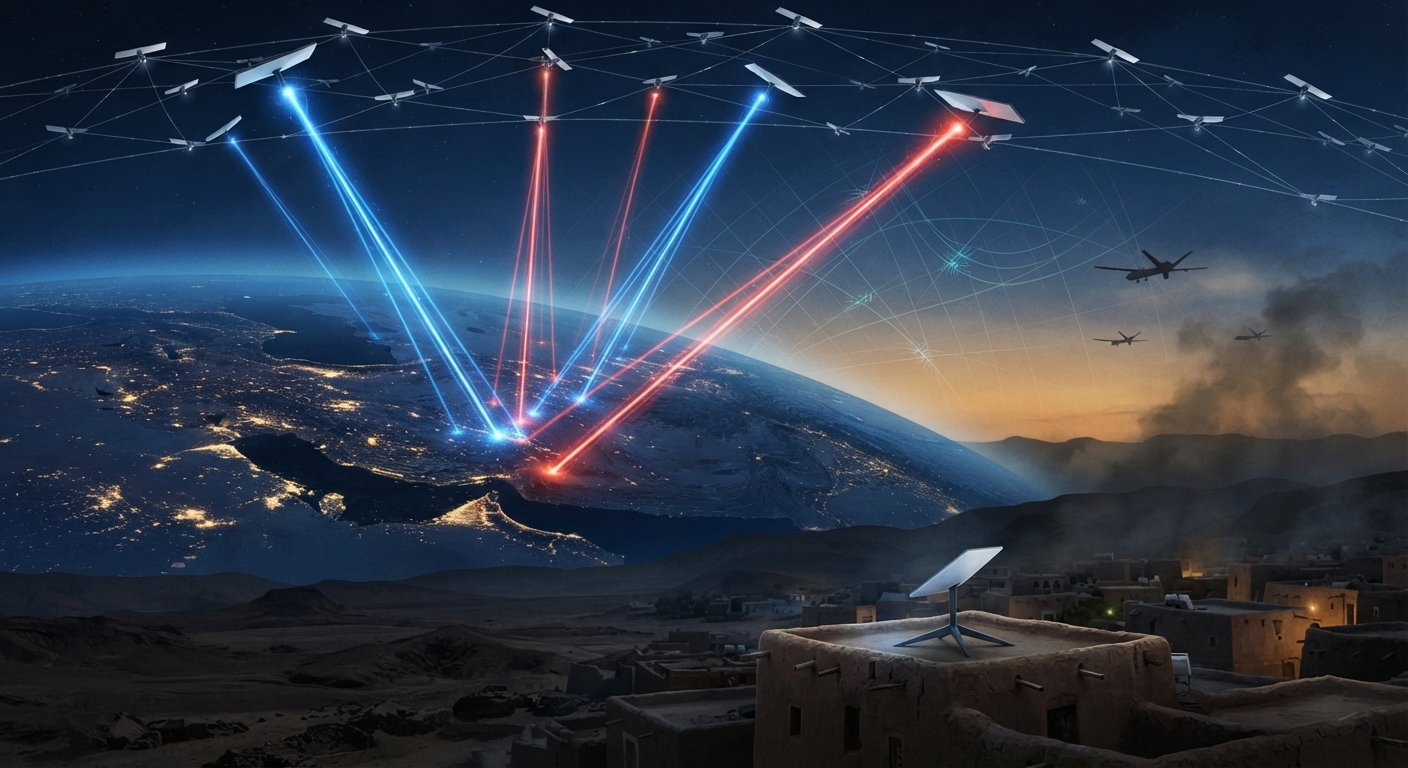
Ironically, while Iranian military units reportedly leveraged Starlink for tactical communications, the government in Tehran has simultaneously waged an aggressive domestic campaign against the technology.
Labeling Starlink an illegal “tool of war” and an instrument of foreign espionage, Iranian authorities have maintained tight restrictions on conventional internet access since the February strikes while intensifying efforts to hunt down illicit satellite dishes.
Iranian security forces have conducted widespread raids, deployed electronic jamming and GPS-spoofing technologies to disrupt satellite signals, and enacted severe legal penalties for anyone caught possessing, importing, or distributing Starlink hardware.
These severe legal penalties included lengthy prison sentences and potential national security charges.
Tehran has also sought diplomatic intervention through international regulatory bodies, formally complaining that the unauthorized operation of SpaceX terminals within its borders violates national sovereignty.
The Impossible Dilemma of Dual-Use Technology
For policymakers in Washington and engineers in Hawthorne, California, the crisis highlights an enduring vulnerability of dual-use commercial space infrastructure.
Technically, SpaceX possesses the capability to geofence and deactivate satellite coverage across all of Iran.
Yet doing so would sever the primary communications channel connecting tens of thousands of Iranian civilians, journalists, and dissidents to the outside world.
“Internet and social media is the only way for Iranians to voice what’s happening inside the country,” noted Holly Dagres, a senior fellow at the Washington Institute.
He added that the Trump administration has remained reluctant to see that connectivity severed precisely because open-source reporting from inside Iran is vital when diplomatic presence is absent.
Industry executives echo that once commercial terminals enter the black market or conflict zones, preventing them from falling into the hands of state adversaries becomes nearly impossible without penalizing the civilian population.
As regional tensions simmer and the prospect of renewed hostilities looms, the struggle over Iran’s skies serves as a stark reminder that in the era of commercial satellite constellations, the line between humanitarian connectivity and military weaponry has become perilously thin.***











Komentar Pembaca
Belum ada komentar pada artikel ini. Jadilah yang pertama.
Minimal 10 karakter, maksimal 1000. Maksimal satu tautan. Semua komentar ditinjau redaksi sebelum tampil.